The thematic consultant on architect Bertram Goodhue’s design team guided the artists Hildreth Meiere and Lee Lawrie in the decoration of the Nebraska State Capitol. While the overall theme of the Capitol was to represent the state of Nebraska and its growth and development, Hartley Burr Alexander, Ph.D. believed that any representation of Nebraska should include Nebraska’s first people. Therefore the Capitol contains artwork and symbolism which feature Native American themes. Most significantly the East Legislative Chamber was decorated to represent Aboriginal Culture of the Great Plains.
Native American Inspired Artwork
Native American themes in the Capitol
Historical context
When Europeans arrived on the American continent they sought to control the land and resources with little regard for the indigenous people. As the English colonized the Atlantic coastal region, the French and Spanish claimed areas west of the Mississippi River. France sold their claim to the western watershed of the Mississippi to the United States in the Louisiana Purchase of 1803. In 1804 Thomas Jefferson sent the Lewis and Clark Expedition to establish diplomatic and commercial ties with tribal nations and chart an overland route to the Pacific Ocean.
As the United States expanded, tribes forced from their Great Lakes, Ohio River and southeastern homelands moved into the Louisiana Territory. Forced relocation brought disease, starvation and conflict. The Oregon Trail and the transcontinental railroad further eroded tribal claims to western homelands. Through conflict and by treaty, tribal land was taken and reservations were established. From the early 1800’s through the 1950’s the United States government enacted policies to assimilate tribal people into the dominant culture.
As this third Nebraska State Capitol was being constructed in the 1920’s attempts were still underway to eliminate Native American culture. Within this context, University of Nebraska Professor of Philosophy Hartley Burr Alexander’s thematic program for the Nebraska State Capitol stands out. He included, rather than eliminated, Native American culture in the story of Nebraska. Artistic details representing Nebraska’s first People are included in the symbolism of the chambers visited by the public and used by the three branches of government.
When Capitol architect Bertram Goodhue proposed to place winged bison on the north steps as a prairie interpretation of the winged figures used on ancient temple gates, Alexander convinced him an accurate representation of the Plains Indian cultural icon was more appropriate. Together, Capitol architect Bertram Goodhue, thematic consultant Hartley Burr Alexander, sculptor Lee Lawrie and mosaicist Hildreth Meiere created an artistic program—progressive for the time—in the nation’s first truly vernacular state Capitol.
Nebraska, from the Otoe-Missouria words meaning ‘flat water’, was created in 1867 from lands with historic and regional connections to the Pawnee, Ponca, Omaha, Otoe-Missouria, Iowa, Winnebago, Mandan-Hidatsa-Arikara, Arapaho and Cheyenne, Pottawatomie, Sac and Fox, Kickapoo, and Lakota, Dakota and Santee Sioux Tribes. Today the Omaha, Winnebago, and Santee Sioux Tribes have reservations in Nebraska. The Northern Ponca Tribe holds tribal land in trust.
Native themes in historical context
Many factors influence artists. Capitol architect Bertram Goodhue’s design for Nebraska was influenced by the prairie and incorporated Gothic design elements via his artistic team, sculptor Lee Lawrie and muralist Hildreth Meiere. As a non-Nebraskan, Goodhue discussed his ideas for the artwork with Hartley Burr Alexander, Ph.D. Upon Goodhue’s untimely death, thematic consultant Alexander was left to fulfill Goodhue’s artistic vision using his knowledge of Nebraska’s culture and civilization to guide the artists. The thematic program Alexander created focused on civilization with agriculture as the foundation for the development of art, religion and government.
Classically trained sculptor Lawrie’s multi-year association with New York architect Goodhue required he sculpt in styles appropriate to Goodhue’s architectural settings. For Nebraska’s Capitol, Lawrie’s tower sculpture became geometric and exaggerated to compliment the building’s simple facade. The relief panels around the base are sculpted in the style of the historic periods referenced. Capitol mosaicist Hildreth Meiere studied art in Italy and was well suited to create the interior mosaics. She adapted her artistic style to represent Alexander’s themes creating mosaics ranging from classical nudes in the floors to realistic images in the ceilings.
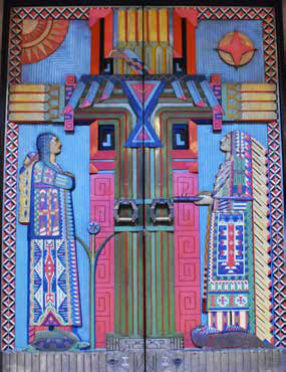
Alexander’s scholarly study of Native American cultures enabled him to guide the artists as they creatively interpreted the artistic traditions of Native Americans to portray the indigenous themes in his program. Meiere’s Native American images were influenced by the pictographs and ledger drawings of Plains tribes. Lawrie interpreted Mesoamerican sculpture in his work.
Artistic representation
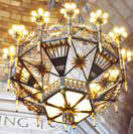
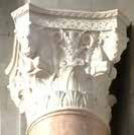
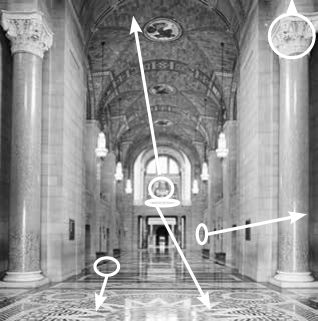
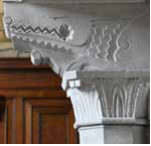
The use of Nebraska specific imagery was part of Nebraska State Capitol architect Bertram Goodhue’s response to the requirement that the new Capitol be a symbol of the state. These design elements represent the Native American and pioneer heritage of Nebraska. The use of icons—corn, wheat, bison, arrows—in the design of the column capitals, light fixtures and other elements visually identify the Capitol as Nebraska’s and unifies the ornamentation.
Where to see it
The north entrance
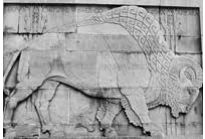
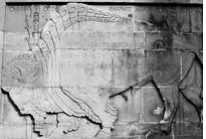
The bison panels at the front entrance of the Capitol include a cow and calf, left, and bull, right. Alexander included names of tribes with ties to Nebraska, acknowledging the first people to call Nebraska home.
Governor’s Suite
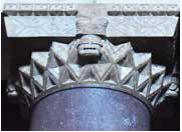
The Governor’s Suite is decorated in an Italian Renaissance style using the corn motif in the decorative detail of the Suite. Corn is stylistically portrayed in a renaissance manner in the marquetry of the walnut wood wainscoting and fireplace medallions. The large Indiana limestone fireplace in the Reception Room features carved bison heads with corn hanging from the horns.
Court of Appeals
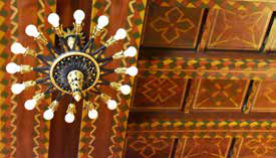
The Court of Appeals Chamber features Native American motifs. The chamber’s walnut wood-beamed ceiling is hand stenciled with a geometric floral motif. Woodland tribes moving onto the prairies simplified their traditional floral motifs in response to the grasslands. The bronze lamps that hang from the ceiling contain a bundle of arrows in the center of a sunflower within a sunburst.
Memorial Chamber
At the top of the Capitol, the Memorial Chamber honors civic and military service through the dignified use of black marble and eight murals depicting citizens in service of others. The blue tile dome features a sun mosaic at its apex with golden rays shining outward. The dome can be interpreted as the sky and the chandelier, Venus, as the morning star, shining in it. Nebraska’s first People watched the sun and stars to guide the planting of fields and the timing of bison hunts. The bronze and enamel light fixtures feature corn and native thistle motifs.
East Legislative Chamber and Lounge
Lawrie’s bronze “Sower” on top of the Capitol spreads the seeds of agriculture across the prairie; the mosaic Thunderbird beneath emphasizes the importance of water to Nebraska’s agricultural people, past, present and future. The East Chamber doors continue this agricultural theme with a central image of corn.
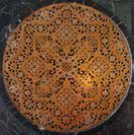
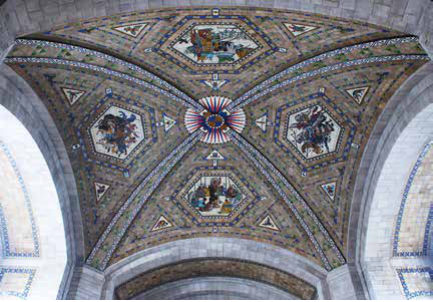
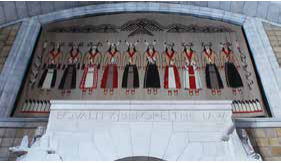
In Alexander’s interior thematic program focusing on society, the two Legislative Chambers symbolically represent branches in a tree of life featuring the two peoples building agricultural societies on the Plains. The East Legislative Chamber and Lounge focus on the aboriginal life of Nebraska’s first People. With Alexander’s guidance, mosaicist Meiere stylistically references native bead work and the ledger book drawings of Lakota artists Kills Two to portray activities of tribal life in the ceiling mosaics and Amos Bad Heart Bull to create the Sundance tapestry above the Speaker’s Niche. Lawrie’s engaged figures on the Speaker’s Niche portray tribal wisdom, with the Counselor and Guide.
Above, large ceiling mosaic panels portray, clockwise from top, Women Growing Corn, the War Party, the Council Fire, and the Bison Hunt with associated cultural items shown above. Below center, the Sundance tapestry hangs above the Speaker’s Niche which is carved with figures of tribal wisdom, the Counselor holding a pipe left, and Guide with hand raised, right.
Indigenous people across the Americas grow dozens of varieties of maize or corn, some used for specific food purposes and some for ceremonial purposes. Nebraska’s non-native farmers grow hybrids of native corn.
Nebraska Hall of Fame
One of the Chamber’s murals portrays Ponca Chief Standing Bear at the point he tells Judge Elmer Dundy in an Omaha, Nebraska federal courtroom they both bleed the same color and declares, “I am a man.” Judge Dundy’s 1879 decision granting Standing Bear’s Writ of Habeas Corpus allowing his band of Ponca to return to their Nebraska homeland was the first time a Native American was declared a person under the United States Constitution.
Native American members of the Hall of Fame include Standing Bear (1829–1908), Ponca Chief and symbol for Indian rights; Susette LaFlesche Tibbles (1854–1903), Indian spokeswoman, artist and writer; and Red Cloud (1821–1909), Oglala Lakota warrior and statesman.